
Completion requirements
Closes: Friday, 8 July 2050, 11:47 AM
Ironing Process
Ironing or often called pressing can be defined as, 'a defined, moist and warm stabilization process of ironing includes all planned processes that use the material-specific glass transition point of fibers to facilitate processing. This processing can be reshaping or surface processing. The “ironing” process is mainly used in the manufacture and restoration of clothes.
The three main parameters of ironing are the effects of heat, the introduction of force (mechanical or aerodynamic), and the introduction of moisture. The process follows the principle that moisture either protects the fibers or makes it easier for the heat to reach the glass transition point of the fiber. Only then does the processing take place through the introduction of force. The effects achieved are only of a temporary nature. The heat exposure must never reach or exceed the melting or decomposition temperature of the fibers.
In the mass production of clothing, ironing is widely used during the clothing manufacturing process and especially after the garments have been sewn. It is the final production stage where the garments are made shipment ready and final packaging. The ironing not only improves the overall appearance by removing unwanted creases which appear by the material handling during sewing production. By restoring the smooth surface the garment appearance is approved and becomes more presentable to the end customer. During ironing, the creases may be introduced intentionally to create pleats on skirts or center creases on formal trousers.
The ironing process involves the application of the following process parameters which are used individually or in combination with one another.
- Heat
- Moisture
- Pressure
- Air
- Time
Conventionally in apparel production, the ironing involves applying heat, moisture (steam), and pressure to get desired results. In thermodynamic aspects, the pressing involves heat transfer via conduction and convection. In direct form when the garment is in contact with the press, the heat transfer through conduction takes place. Air is usually used to cool down the fabric during setting and uses both blowing and suction principles uses the convection. The ironing process first changes the shape of the fabric by deforming it, gives it a new form, and finally sets it to its new shape.
To the topic of pressing there is not much scientific literature available. The possible factors which influence the process of ironing are shown in the table below.
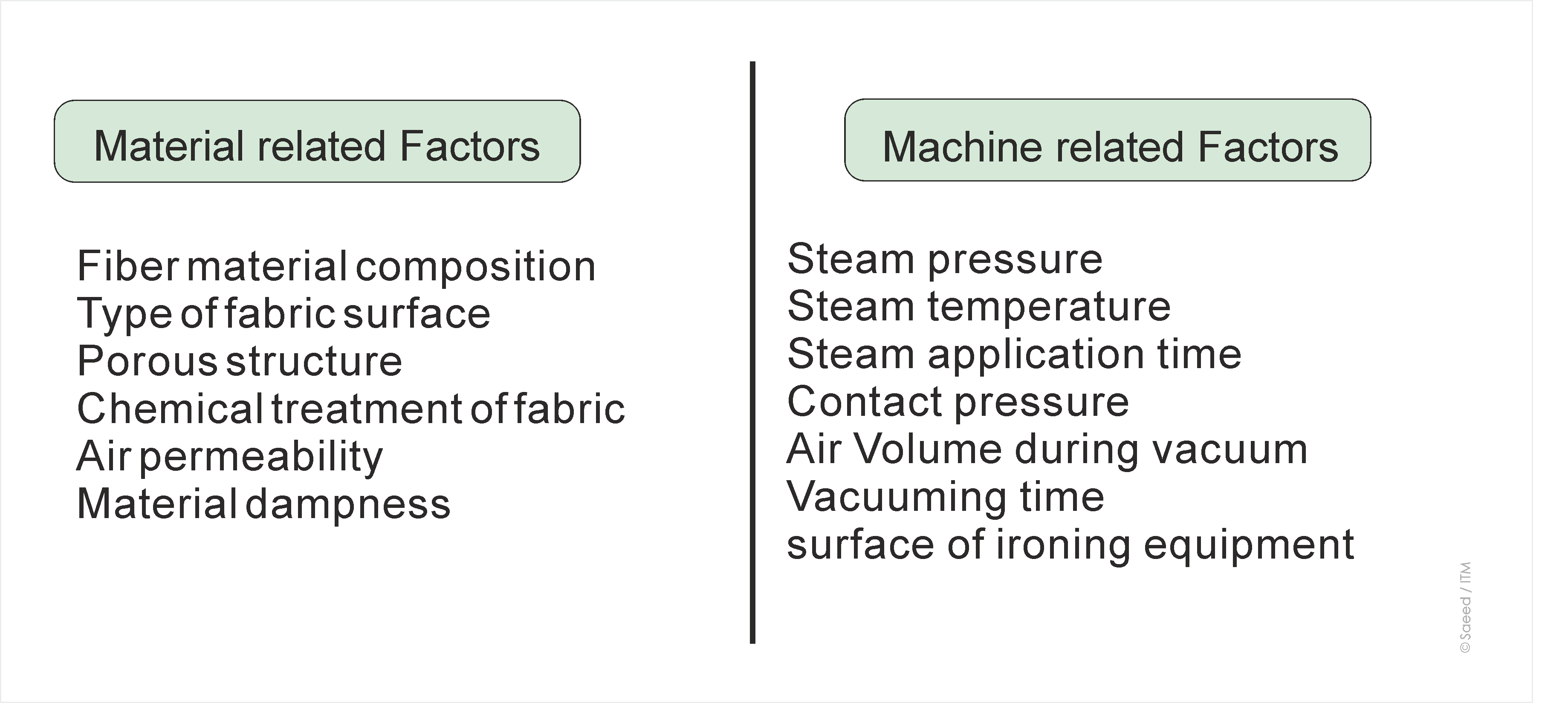
Factors Affecting Pressing [Prof. Nestler]