
Completion requirements
Closes: Thursday, 30 June 2050, 4:33 PM
What is a Marker
Spreading is the process of laying of fabric in superimposed plies of
specific length. This provides the foundation for placing the marker on
top of spreading layer.
Marker
The marker (also known as lay plan) can be printed on a piece of paper or may be digitally transferred directly to automatic cutting machine. The marker is made for usable width of fabric. Around 50 % of garment cost is associated with fabric cost and the marker design plays an important role for efficient use of fabric. One of the key marketing point for CAD solutions for pattern making, grading, marking making system for automatic cutting machines is the efficient use of fabric and high marker efficiency of fabric lay.
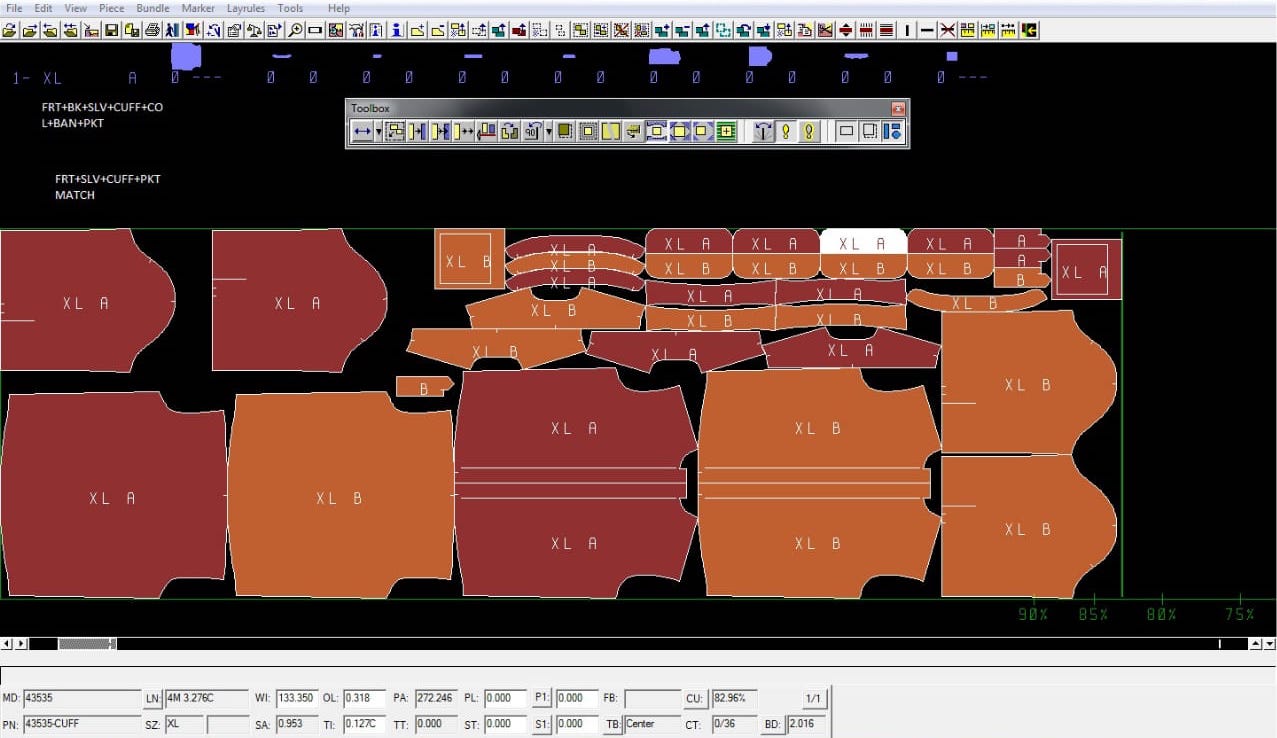
Marker Plan
Cutting-Marker utilisation can be calculated through following expression:
Ic-mar = ( AN / AG) * 100
where: AG = L c-mar * W c-mar
The intercutting losses are calculated as:
IIL = (AG- AN / AG ) * 100
where:
Ic-mar : cutting marker utilisation in %
AN : cutting-marker net surface, in cm2
AG: cutting-marker gross surface, in cm2
IIL: intercutting losses in %
Lc-mar: cutting-marker length in cm
Wc-mar: cutting marker width in cm
Fabric Losses
The fabric losses are highly important for apparel manufacturer. a great deal of effort is carried out to reduce these losses to minimum as possoble. The losses can be divided in to mainly direct and indirect losses.
Direct fabric losses include:
- losses at the end of the cutting ply,
- losses along the cutting ply length
- end of piece losses
- splicing losses and fabric faults
Indirect losses include:
- Losses due to remaining fabric in rolls as a result of fabric fault.
- losses due to differences in fabric roll length
- losses occurring during cutting-marker making
Length of Spread
The length of spread is related to the marker length. It is not rational to design a smaller length spread because more fabric ends have to be cut and more lays of fabric has to be spread to get a same number of cut pieces. Of course, it is a compromise of space availability but it is not efficient to lay short spread. The optimal length of a 'manually' performed spread is 4-7 meters.
Fixing Marker on Spread
The marker is printed on a paper roll on special printer and is fixed on top of the spared with the help of clamps so that it doesn't move during cutting. The marker paper might be damaged by the clamps, therefore and extra relatively rigid paper can be used in the clamping area. This may especially happen with softer fabric.
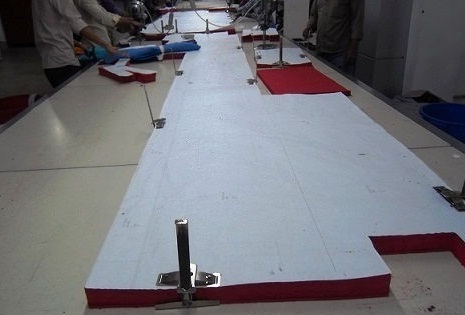
Spread fixing with clamp (Source)