
Completion requirements
Closes: Tuesday, 5 July 2050, 12:24 PM
Types of Automatic sewing machines
CAM Controlled
This is a specialized type of automation that has been used in early sewing automation especially in the last quarter of the 20th century. Special cams control the movement of the components to be sewn during the complete sewing process. The machine operator places the sewing material at the machine in right place, starts the job, and the sewing operation is completed in one go. These cam-controlled sewing automats were also equipped with a certain safety mechanisms that may halt the process if some fault occurs like the thread breakage.
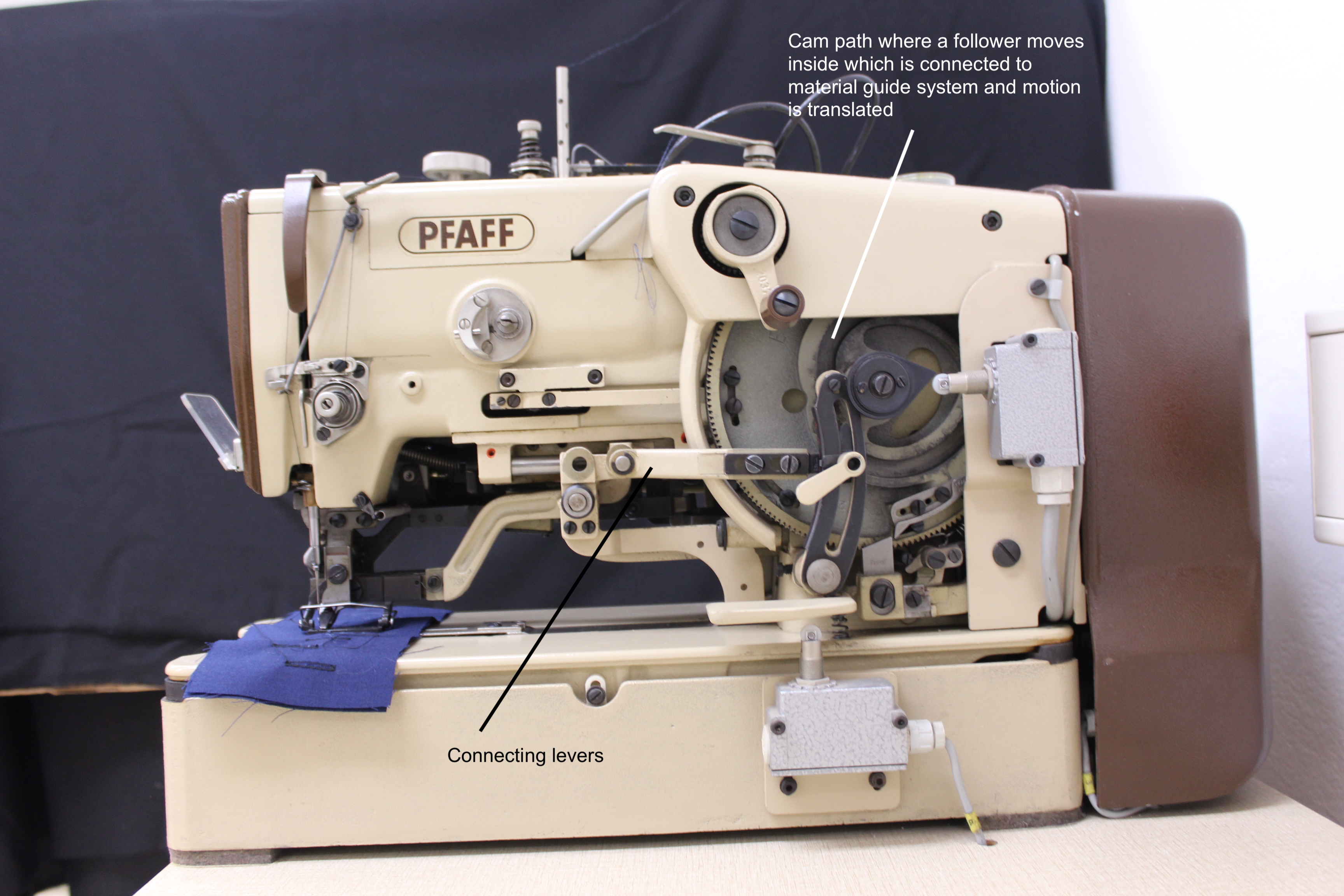
Buttonhole cam controlled automat
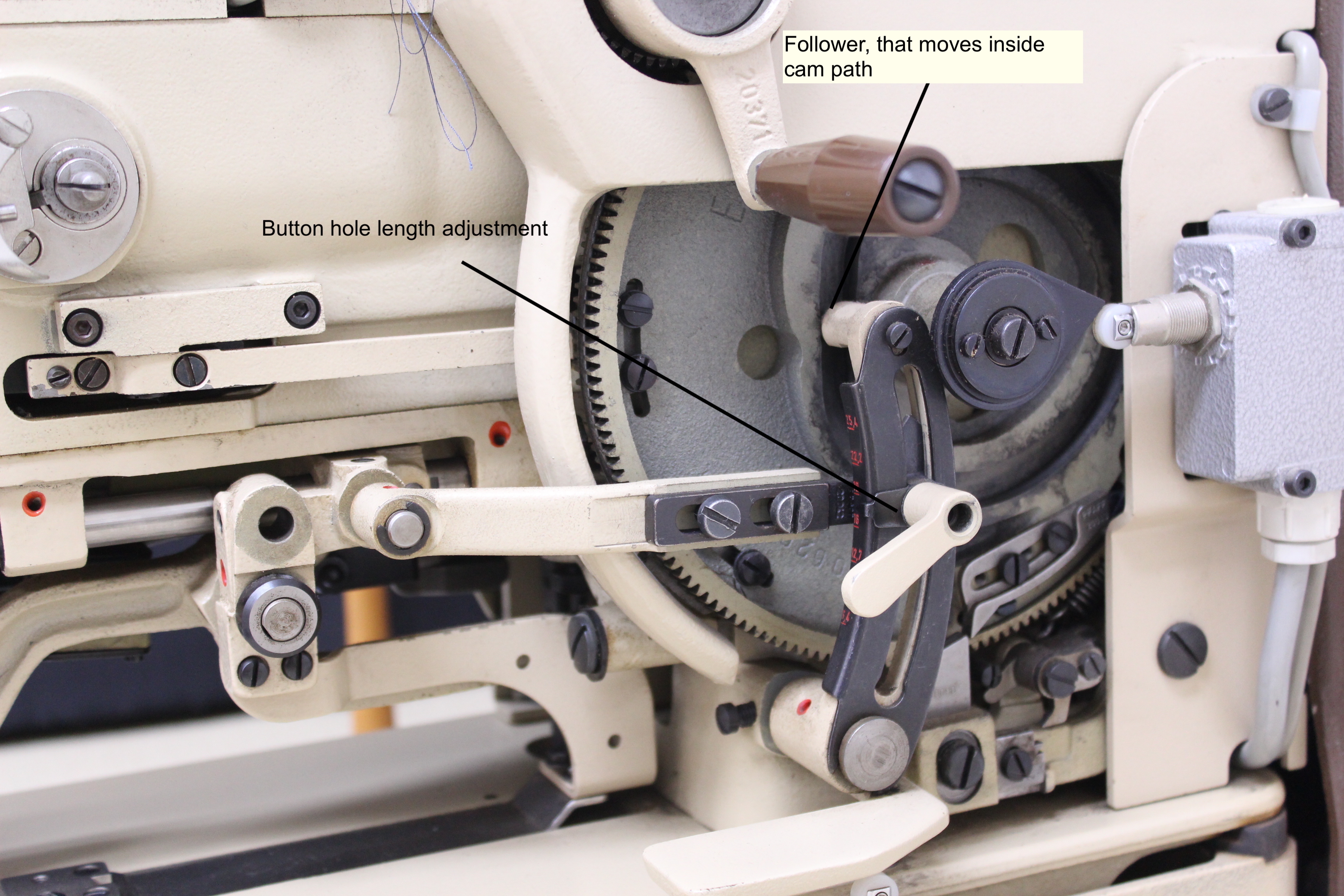
Cam path
These cam automatic machines offer limited flexibility. If a new design of the buttonhole as shown in the above example is required, the cam has to be changed. The follower, which follows the cam path only may increase the dimensions of the pattern. To change the pattern design, a new cam is required. These cams-operated automats are used in generic machines like barrack, loops attachments, buttonholes etc.
CNC Controlled
A CNC (Computer Numerical Control) machine is a motorized maneuverable tool and often a motorized maneuverable platform, which are both controlled by a computer, according to specific input instructions. Instructions are delivered to a CNC machine in the form of a sequential program of machine control instructions such as G-code and M-code, then executed. The program can be written by a person or, far more often, generated by graphical computer-aided design (CAD) software and/or computer-aided manufacturing (CAM) software.
In apparel production, material transport usually involve work in two dimensions i.e. X and Y. In these dimensions, either the material can alone move in these dimensions or may be a combination of both material and machine.
Type 1
In this type of CNC machine, the material moves in both X and Y dimensions. The sewing head remains fixed at its place. The graphic illustration shown below shows the schematic. It can be seen that requirement of space for one machine. In the case of quilts, the space requirement increases a lot and the machines halls are required to be designed efficiently for maximum space usage.
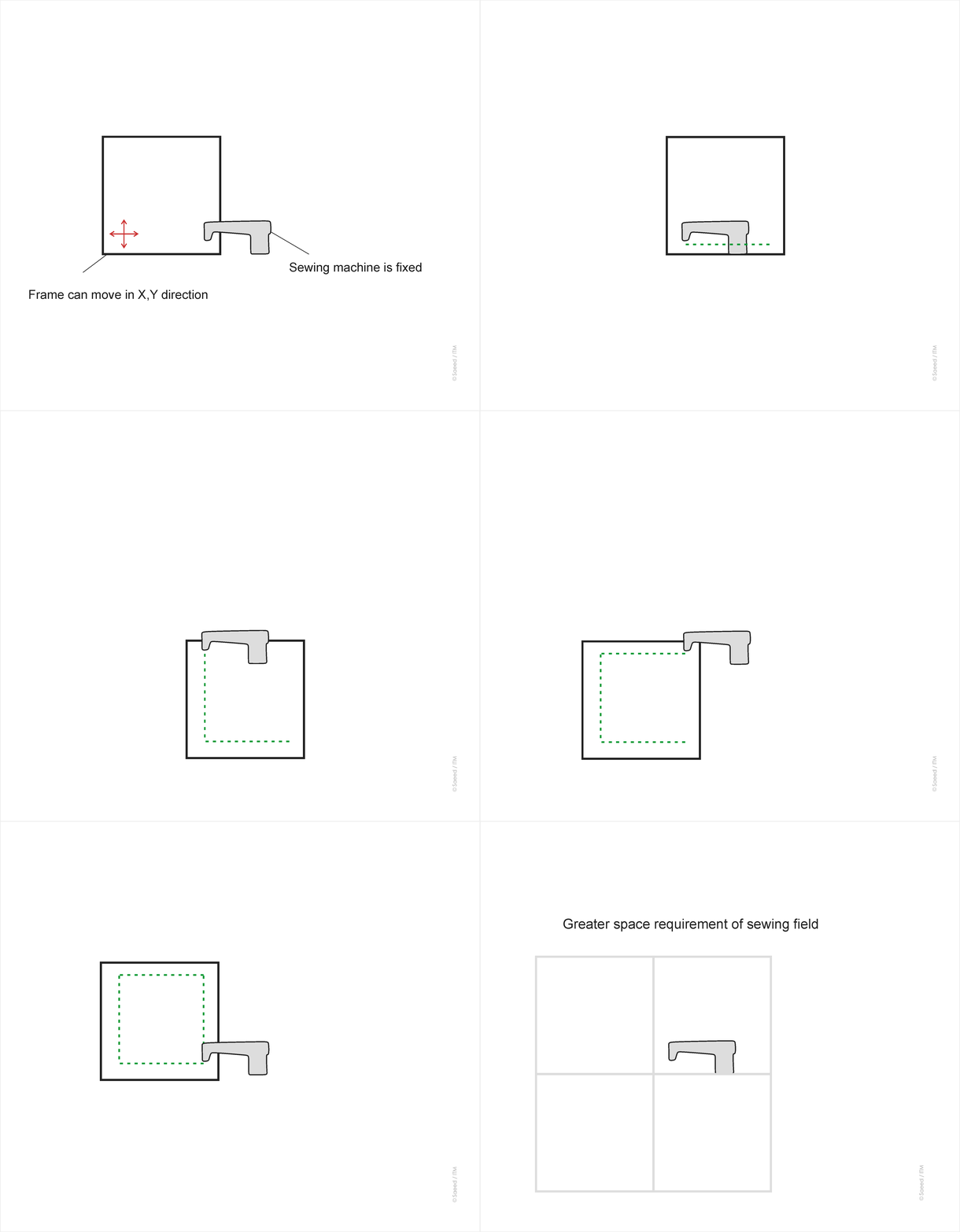
Type 1 CNC
Type 2
In this type of CNC machine, a combination of movement of both material and sewing head. Each component moves translatory in only one dimension. The graphical illustration shown below shows the movement of both material and machine head. It can be seen as compared to the above example, the sewing machine requires almost half-space.
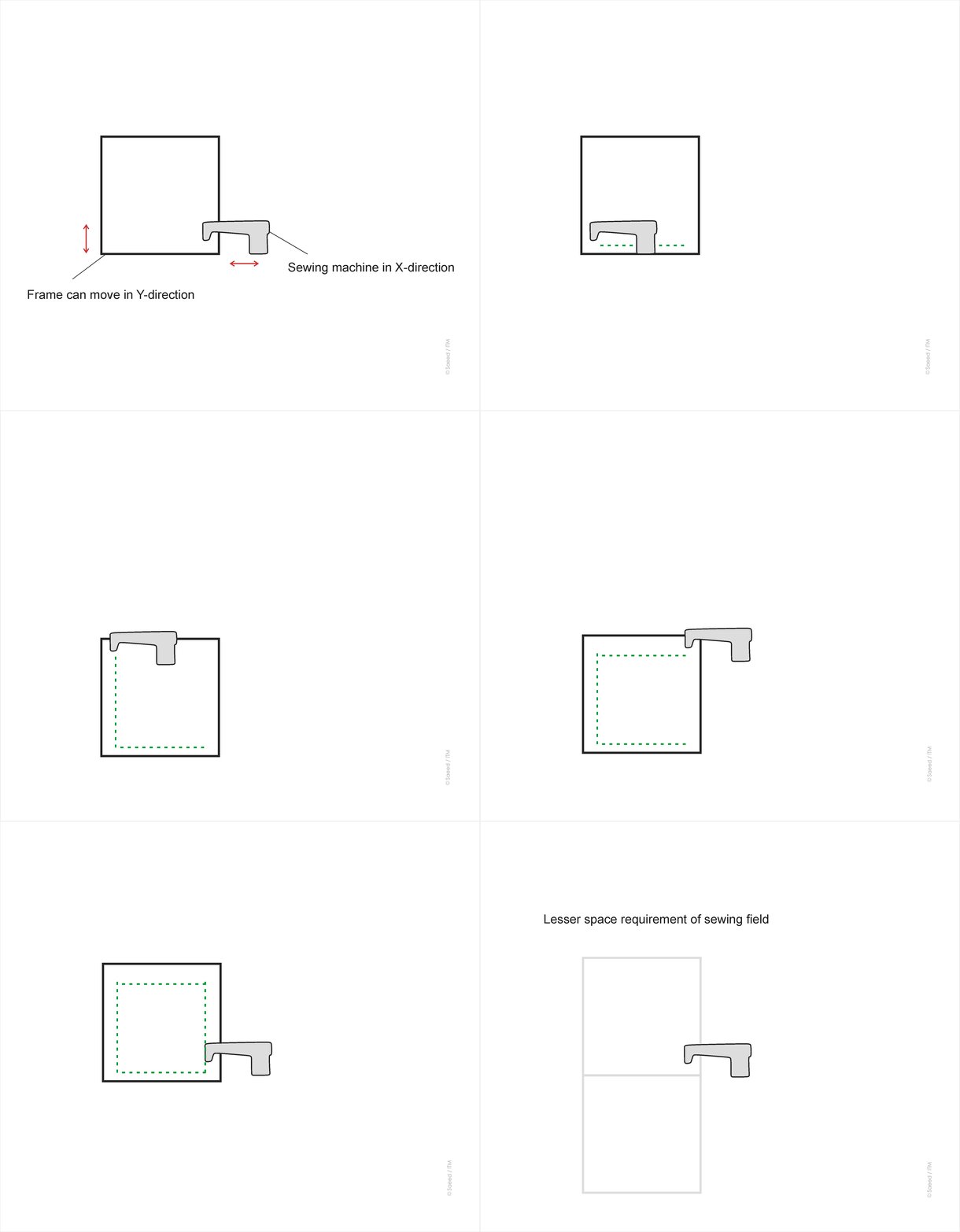
Type 2
In technical development of drive technology with controlled motors, needle, and gripper (hook) can be driven by two separate motors with electronically regulated transmission ratio and rotation angle regulation of the two drive shafts. This results in the possibility to carry out an offset of the sewing head instead of offsetting the product in one or both coordinate directions. The area required for these automated sewing machines is thus reduced to twice the product area, or even further to only the product area. For CNC controls, a task-adapted program ensures that radii, stitch lengths, starting/ending angles, or other relevant seam contour parameters can be chosen freely within the construction-inherent limits. [H, Rödel]